
A message needs to reach the far end of a warehouse. A supervisor needs to speak to a crew working beyond the next building. An event organizer needs a quick answer without waiting for a phone to ring. These moments explain why the humble two-way radio remains relevant: a single button can connect people who are already doing something else.
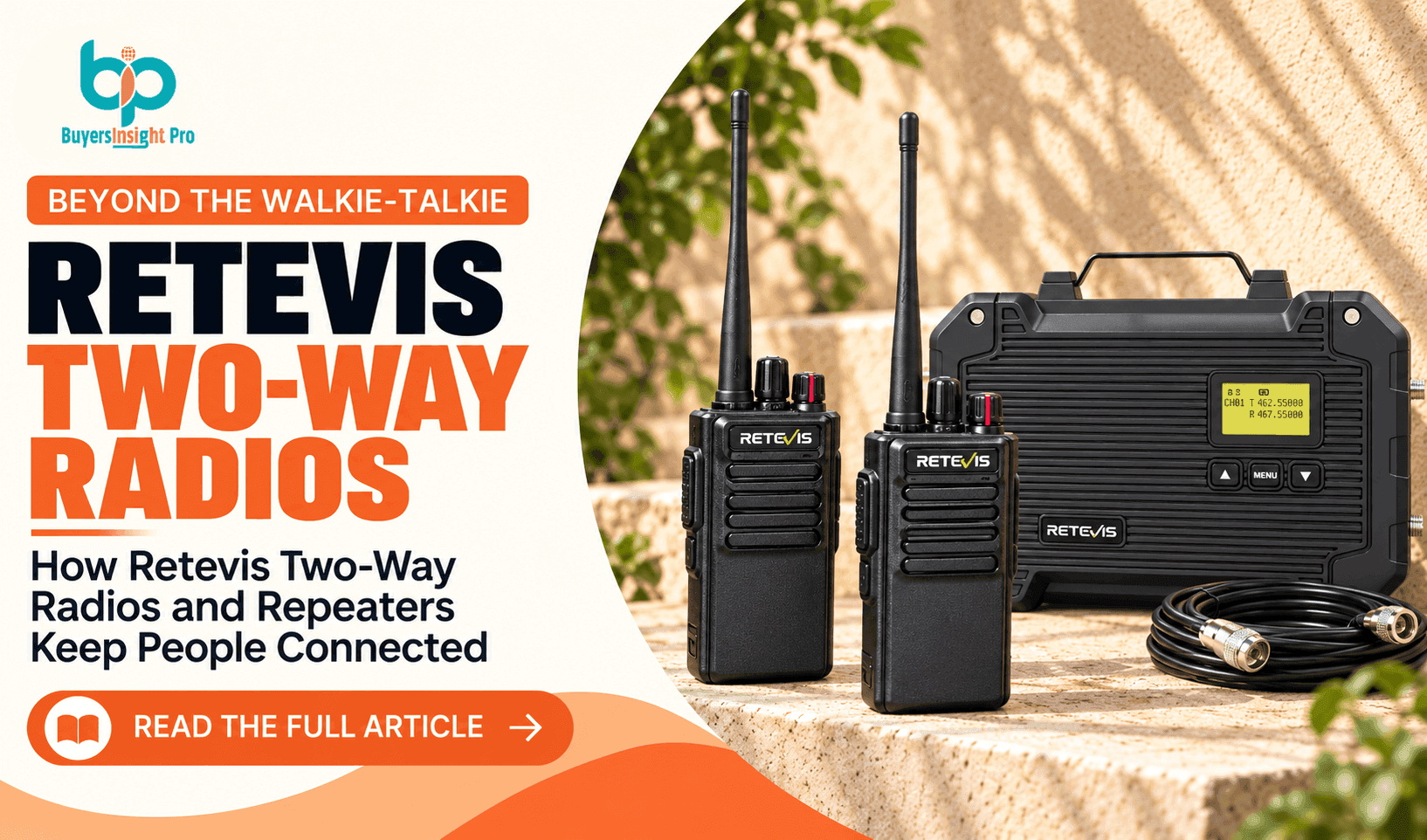
Retevis builds around that simple interaction, but its product range extends far beyond a pair of recreational walkie-talkies. It includes commercial handhelds, digital mobile radio systems, GMRS equipment, portable repeaters, vehicle radios and accessories intended for teams that communicate repeatedly throughout a shift. The story is less about replacing a smartphone than about giving a group a shared, purpose-built communication channel.
This product feature explores the equipment itself: what distinguishes a rugged handheld from a compact everyday radio, how digital communication changes the experience, why a repeater can transform a radio network and how accessories make hands-busy communication practical. Along the way, examples from Retevis's current catalog show how separate devices become a coordinated system.
This is an editorial exploration of Retevis products, not a step-by-step shopping guide or a hands-on review. Descriptions are grounded in the manufacturer's published specifications; stated ranges are conditional, not guaranteed, and legal operating requirements vary by country and radio service.
See Retevis handheld radios, professional systems and repeater solutions in the official catalog.
Explore Retevis Products →The Power of Push-to-Talk in a Connected World
In a busy workplace, communication is a workflow. A radio allows one person to make a short announcement to everyone monitoring the same channel without building a call list, searching for a contact or expecting colleagues to look at a screen. That shared-audio approach suits dispatch, stock movement, site coordination and routine safety check-ins.
Two-way radio communication also has clear limits. Conventional handhelds depend on radio coverage, antenna placement, terrain, building materials and interference. They do not automatically provide unlimited range, and they are not a substitute for a resilient emergency plan. Yet within a well-designed coverage area, the directness of push-to-talk can be difficult to replicate.
Retevis has organized its catalog around this practical advantage. Its professional-radio collection includes rugged handhelds and bundles, while its industry pages cover construction, warehouses, hospitality, manufacturing, security and farming. These categories reflect different communication environments rather than a single universal device.
Retevis Handheld Radios: Small Devices With a Clear Job
A handheld two-way radio is deliberately simple at the point of use: power it on, select the approved channel, listen and transmit. Beneath that straightforward interaction, devices can differ substantially in battery capacity, channel programming, speaker output, environmental protection and accessory connections.
The Retevis RT29 appears in the brand’s professional lineup as a high-power, long-range business handheld, including a four-pack offered with shoulder speaker microphones. The emphasis is on durable group communication for crews rather than decorative features. A shoulder microphone can help when the radio stays clipped to a belt, although the cable and clip arrangement still need to suit the task.
Other compact models prioritize portability and simpler day-to-day operation. That distinction matters in practice: a hotel team moving between floors may prioritize a light radio and a discreet earpiece, while an outdoor maintenance crew may care more about glove-friendly controls and protection from dust or water.
The most effective handheld is the one that remains usable during the actual job. Buttons, volume, belt clips and battery changes are all small details until the moment someone must communicate quickly.
Rugged Construction and the Reality of Demanding Environments
Professional radio pages frequently emphasize resistance to rain, dust and impacts. Those qualities are especially relevant where equipment moves between trucks, loading bays, workshops and outdoor sites. A handheld can be dropped, splashed or pressed against protective clothing many times during a shift.
Environmental ratings such as IP67 describe testing against specified dust and water conditions, not invulnerability. Retevis identifies the RT29D digital handheld as IP67 in its RT97P-and-RT29D repeater solution. That is a meaningful specification for this particular model, but it should not be generalized to every radio in the catalog.
A rugged shell is only one component of reliability. Battery contacts, accessory ports, antennas and charger connections also matter. Routine checks and properly fitted accessories can make a bigger difference to day-to-day readiness than dramatic claims about surviving extreme conditions.
Digital Radios Bring Another Layer to Team Communication
Analog radios are familiar and can be effective for straightforward voice communication. Digital Mobile Radio, commonly called DMR, introduces a different architecture that can support digital voice and additional operational features depending on the equipment, configuration and licensing.
Retevis lists digital handhelds such as RT81, RT29D and NR30D alongside the RT97P DMR repeater. These are examples of a product ecosystem rather than isolated gadgets. The radio, repeater and programming settings must work together; simply owning devices labeled digital does not guarantee interoperability.
Digital systems can be attractive for larger operations seeking structured channel use, but they also create responsibilities around setup, programming and ongoing management. A business that needs only occasional short-range calls may not require that complexity. For a larger team, however, a properly configured digital network can become part of everyday operations.
The distinction is not that digital is universally superior. It is that Retevis provides equipment for both simpler radio conversations and more structured communication systems.
The RT97P: A Portable Repeater That Changes the Shape of a Network
The RT97P is one of the clearest examples of Retevis moving beyond handheld radios. A repeater receives a transmission and retransmits it, helping compatible radios communicate where direct radio-to-radio coverage is insufficient. Placement, antenna quality and terrain determine how much improvement is possible.
Retevis lists the RT97P Mini Portable DMR Repeater with a 10-watt rating, eight DMR channels and 12–24-volt DC power options. The company describes compatibility with radios including NR30D, RT29D, RT81 and RT50, subject to correct frequency and system configuration. It is offered as a compact unit suitable for deployments where a large permanent installation would be impractical.
What makes a repeater interesting is the shift from device thinking to network thinking. A team might have perfectly functional handhelds yet encounter a dead zone behind a ridge or inside a distant building. Improving coverage may depend more on repeater placement and antenna installation than on purchasing more powerful handhelds.
The RT97P does not guarantee a particular number of miles. Retevis advertises range-oriented bundles, but real results vary widely with terrain, structures, frequency, installation and regulatory power limits.
GMRS Repeaters: RT97, RT97S and RT97L
Retevis also sells GMRS-oriented repeater equipment, including RT97, RT97S and RT97L variants. The RT97S is promoted as a compact portable GMRS repeater with a built-in duplexer, making it possible to receive and retransmit on paired frequencies when correctly installed.
The brand’s RT97S and RB17P package combines a repeater with handheld radios. Its listing describes eight repeater-capable channels on the RB17P, a 2,200 mAh battery and weather alerts. Those features illustrate the appeal of an integrated system: the components are presented together for a particular communication purpose.
Retevis also markets higher-power RT97L solutions for farms and large properties. More output power can be relevant in system design, but power alone does not determine coverage. Antenna height, terrain, feedline losses, interference and licensing remain central considerations.
GMRS is a specific radio service with country-dependent rules; in the United States it has FCC licensing requirements and designated frequencies. A GMRS product sold on an international website is not automatically lawful to transmit with in another country. That regulatory distinction matters as much as the equipment specification.
From Handhelds to a Complete Radio System
One handheld radio is a device. Several compatible radios, charging stations, accessories and a repeater can form a system. Retevis sells bundles that make this relationship visible, including an RT97P-and-RT81 DMR kit with an antenna and an RT97S-and-RT86S GMRS communication package.
A coordinated system can simplify fleet deployment because radios are selected for compatible services and intended uses. Still, a bundle is not proof that all programming is complete or that coverage will be adequate. Frequencies, privacy codes or digital settings, antenna placement and operating authorization need to be addressed.
For an organization, the more valuable question is how communication will flow. Who needs to hear all calls? Are separate workgroups necessary? Is there a dispatcher or fixed base? Where do radios charge between shifts? Those decisions determine whether equipment helps or creates extra noise.
Retevis’s system bundles are compelling because they illustrate how repeaters and handhelds fit together. They should be understood as configurations for specific situations, not as promises of guaranteed distance.
| Retevis equipment | Role in communication | Published example |
|---|---|---|
| RT29 / RT29D handhelds | Crew voice communication | Rugged business and digital radio options |
| RT81 / NR30D | DMR fleet radios | Digital handhelds in repeater systems |
| RT97P | Portable DMR coverage relay | 10W class; 8 DMR channels |
| RT97S | Portable GMRS repeater | Built-in duplexer; 8 repeater channels |
| RT97L | Higher-power GMRS repeater systems | Advertised for larger properties |
| Speaker mics, antennas and chargers | Day-to-day usability and infrastructure | Compatibility varies by device |
Communication on Construction Sites
Construction sites change constantly. Equipment moves, walls rise, temporary structures appear and crews spread across different levels or work zones. A radio can keep supervisors, spotters and workers in contact when a voice call or hand signal is impractical.
Rugged handhelds such as the RT29 family fit the general concept of jobsite communication. Speaker microphones can keep the radio secure while allowing more accessible push-to-talk. However, high-noise environments require careful attention to audibility, hearing protection and communication procedures.
A radio is not a replacement for required safety controls, spotters or emergency protocols. Clear channel discipline, standard phrases and training matter just as much as the hardware. In a critical operation, a misunderstood message can be worse than no message at all.
Warehouses and Manufacturing: Communication Across Moving Teams
Warehouses depend on short, repeated exchanges: a pallet is ready, a bay has opened, a delivery has arrived or maintenance is needed. In manufacturing, production, quality assurance and facilities teams may need to coordinate without leaving their stations.
Handheld radios offer a shared communication channel that is not tied to a desk. Multi-unit chargers, spare batteries and consistent channel programming can make deployment more manageable. An earpiece may reduce noise in some settings, while a speaker microphone may be easier to use with gloves.
Large metal structures, storage racks and reinforced walls can complicate radio coverage. This is where repeater planning becomes a real engineering issue rather than a marketing slogan. Site testing is essential before relying on any claimed distance.
Hotels, Restaurants and Events: Communication That Stays in the Background
Hospitality teams often need fast coordination without drawing attention. A front-desk employee might ask housekeeping about a room, a restaurant manager might call for assistance or an event coordinator might direct staff between entrances and backstage areas.
For these uses, comfort, audio clarity and discreet accessories may matter more than maximum advertised power. A bulky outdoor radio can be less suitable for a long hospitality shift than a compact device with a secure earpiece.
Events also create temporary coverage problems. Crowds, temporary stages, concrete structures and changing work zones affect radio performance. Planning channels and testing the site before opening can help reduce confusion during busy periods.
Farms, Outdoor Properties and the Challenge of Distance
On a farm or large property, people can be separated by fields, machinery, outbuildings and hills. A direct handheld connection may work well across one open area and fail unexpectedly behind a ridge. That variation is inherent to radio propagation.
Retevis presents repeater packages for farms and outdoor operations, including combinations of RT97S or RT97L repeaters with compatible handhelds. A repeater placed at a suitable location may extend useful coverage, but its effectiveness depends on installation and local geography.
Power flexibility can matter in remote settings. The RT97P product description identifies 12–24 V DC, vehicle and solar-supported powering arrangements. Such flexibility is useful only when the full power system, weather protection and maintenance plan are appropriate for the site.
Radio communication should be one layer of a rural safety plan, not the sole means of reaching emergency services. Remote users should consider coverage failures and alternative ways to request help.
Explore the RT97 family and integrated radio systems, remembering that coverage depends on terrain and configuration.
Explore Retevis Products →What Radio Accessories Actually Change
Accessories can determine whether a radio feels natural or cumbersome. Retevis’s catalog includes belt clips, speaker microphones, headsets, charging equipment, antennas and repeater accessories. Each addresses a practical problem rather than simply decorating a device.
A shoulder speaker microphone can keep the main unit clipped away while making push-to-talk easier to reach. An earpiece can support discreet listening. A multi-unit charger can reduce the daily task of finding enough outlets. An appropriate antenna and feedline are fundamental parts of a repeater installation.
Compatibility should never be assumed from appearance. Connector designs, programming cables and power requirements vary. Retevis explicitly notes differences between RT97, RT97S and RT97P programming software and cables. Choosing the correct accessory is a technical requirement, not a minor detail.
Accessories also require care. A damaged cable or loose connector can undermine communication even when the radio itself is working properly.
Range Claims: Why Miles on a Product Page Are Not the Whole Story
Retevis advertises several repeater bundles with distance-oriented descriptions, including ten-mile and longer-range scenarios. Those figures are best understood as possible results under stated or favorable conditions rather than distances that every customer will experience.
Radio waves interact with hills, trees, concrete, steel and terrain. Antenna height can be more influential than small differences in handheld output. In cities, dense buildings can block paths; outdoors, a ridge can interrupt an otherwise open route.
Antenna installation, coaxial cable quality, operating frequency, repeater placement and legal power limits all affect outcomes. Two systems using the same product may perform very differently in different locations. That is why real coverage planning matters more than selecting equipment based on the largest advertised number.
Retevis’s range-oriented product bundles are useful illustrations of possible network designs. They should not be treated as an unconditional service-level guarantee.
Battery Power and Charging as Part of the Workday
A radio that lasts through a shift is more valuable than one with impressive specifications but an empty battery at the wrong moment. Battery endurance depends on capacity, transmission frequency, listening time, power settings, temperature and battery age.
Retevis’s RB17P bundle listing cites a 2,200 mAh battery and up to 24 hours of operation, but that is a manufacturer-stated figure dependent on usage. Actual runtime will vary with duty cycle and conditions. A fleet manager should consider spare batteries and charger availability rather than assuming every unit will reach its maximum advertised duration.
For teams that work in shifts, charging infrastructure is an operational decision. Clearly assigned radios, labeled charging positions and periodic battery checks can help keep the system ready.
Privacy, Security and the Limits of Radio Conversations
Radio conversations can be heard by other users with compatible receivers when operating on shared or accessible frequencies. Some digital systems provide additional signaling or security capabilities, but privacy features differ by model, service and configuration.
CTCSS and DCS tones are often described as privacy codes, but they do not encrypt a transmission. They primarily control which signals open a receiver’s squelch. Organizations should avoid discussing sensitive personal or business information over channels without appropriate protections.
Licensing and frequency allocation also vary by region. A radio that can be programmed to a frequency is not necessarily authorized to use it. Professional users should confirm the applicable rules and, where needed, work with qualified radio specialists.
Why Retevis Products Form an Ecosystem Rather Than a Single Gadget
Retevis’s strongest product story is the way handhelds, repeaters and accessories connect. The RT29 family illustrates rugged field communication; DMR models such as RT81 and RT29D represent digital fleet options; RT97-series repeaters address coverage; and microphones, chargers and antennas make daily use practical.
This ecosystem approach makes the brand relevant to both small teams and larger operations. A business may begin with a few handhelds, then discover that building layout or site size creates a need for better infrastructure. Another organization may start with a planned repeater network because its geography demands one from the outset.
The equipment does not eliminate the need for thoughtful setup. It provides the pieces from which a useful communication system can be built. That is a more realistic and interesting promise than simply claiming that every radio works over an enormous distance.
| What stands out | What deserves attention |
|---|---|
| Broad professional radio lineup | Models differ in service, band and programming |
| Portable analog and digital repeaters | Coverage requires installation and testing |
| Bundles pair complementary equipment | Compatibility and settings still need confirmation |
| Accessories support hands-busy work | Connectors and cables are model-specific |
| Applications across many industries | Local radio rules and licensing apply |
| Range-focused system options | Advertised miles are conditional, not guaranteed |
The Human Side of Reliable Communication
Communication equipment succeeds when people trust it enough to use it naturally. A radio should be audible, easy to carry, simple to charge and predictable in the places where work happens. When those basics are right, short exchanges can remove delays and uncertainty from a busy day.
Retevis’s product range shows how far two-way radio has evolved from a recreational walkie-talkie. Rugged handhelds, digital radios, portable repeaters and compatible accessories support different kinds of teamwork, from a small hospitality staff to a dispersed field crew.
The real product story is not unlimited range or a dramatic specification. It is the practical ability to connect the right people at the right moment—provided the equipment is properly selected, configured and operated within local rules.
Frequently Asked Questions About Retevis Communication Products
What does Retevis make?
Retevis sells two-way handheld radios, digital radios, repeaters, mobile radios and accessories for business, industrial and outdoor communication.
What is the difference between a walkie-talkie and a repeater?
A handheld radio lets users transmit and receive; a repeater receives and retransmits compatible signals to improve coverage in suitable locations.
What is the Retevis RT97P?
The RT97P is a compact DMR repeater advertised with a 10-watt rating and eight DMR channels.
What does DMR mean?
DMR stands for Digital Mobile Radio, a digital radio standard used by compatible professional communication equipment.
Does Retevis make GMRS repeaters?
Yes. Its catalog includes RT97, RT97S and RT97L GMRS-oriented repeater products and bundles.
Do Retevis radios work without cell service?
Conventional direct radio communication does not require a cellular connection, but coverage depends on the radio service, equipment and environment.
Can a repeater guarantee ten miles of coverage?
No. Advertised ranges depend on antenna placement, terrain, buildings, interference and operating conditions.
Are Retevis radios waterproof?
Some models have specific water- and dust-resistance ratings, such as the RT29D IP67 listing, but not all models share that rating.
Can Retevis radios be used in warehouses?
Retevis markets professional radio solutions for warehouses, though actual indoor coverage should be tested on site.
Do Retevis radios require a license?
Requirements depend on the country, frequencies, power and radio service. GMRS and business-radio rules are not the same everywhere.
Are privacy codes the same as encryption?
No. Common CTCSS and DCS tones control squelch behavior and do not encrypt conversations.
Does Retevis sell complete radio systems?
Yes. The brand offers combinations of compatible handheld radios, repeaters and accessories, though deployment may still require programming and site planning.
Explore handheld radios, repeater bundles and accessories built for teams and outdoor operations.
Explore Retevis Products →